Oxford Street greenway
The PeripheralOxford Street greenway transforms the ruined course of Oxford Street into a long, elevated forest path. Its trees and planters register the Jackpot’s accumulated damage, while their engineered growth and carbon-collecting function show how the post-disaster city has turned ecological repair into part of its built environment. For Flynne Fisher and Wilf Netherton, walking there makes the distant history of catastrophe tangible in the landscape around them.
From ruined street to greenway
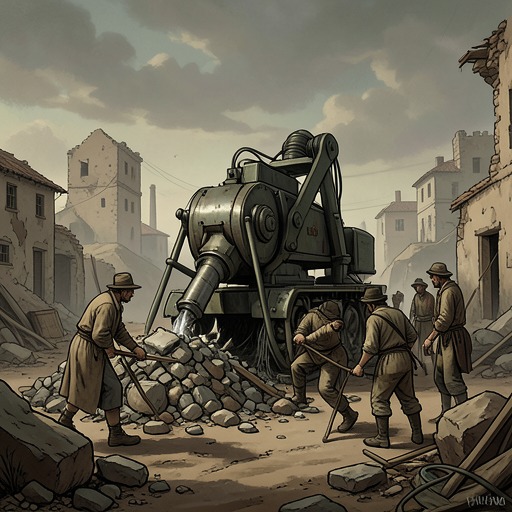
The greenway lies along Oxford Street, which was damaged during the Jackpot, chiefly through the destruction of its department stores. An architect had the assemblers consume and reshape the ruins, converting them into a long planter for trees. A central path rises above the street’s original level, so the former commercial thoroughfare becomes a route through planted space rather than a rebuilt shopping district.
The transformation depends on the assemblers, the nanotechnology that Wilf explains as having helped build and maintain the post-Jackpot city. They did not simply clear the ruins: they were directed to incorporate them into a new form. The greenway therefore preserves the fact of destruction even as it makes that destruction usable, placing remnants of the old city beneath a deliberately constructed landscape.
Trees, technology, and carbon
The vegetation combines biological life with technological intervention. Wilf explains that the trees are real but that their growth has been augmented and engineered. Some are quasi-biological megavolume carbon collectors that resemble trees, joining a familiar urban forest to the city’s response to atmospheric carbon. Their scale and hybrid character make the greenway more than decoration: it is also part of an environmental system shaped by the conditions that followed the Jackpot.
The path is a product of a wider post-catastrophe rebuilding effort. Wilf has told Flynne that the Jackpot was not a single apocalyptic event but a multicausal crisis without a clear beginning or end, driven in part by climate change and compounded by drought, water shortages, crop failures, species loss, and disease. Assemblers arrived later, after the initial die-off, and helped clean buried rivers and build the new urban landscape. The greenway’s planted surface thus belongs to a recovery made possible by technology, but it also points back to the prolonged ecological breakdown that made such intervention necessary.
A walk through the future city
Flynne and Wilf encounter the greenway while walking from Soho Square toward Hyde Park at Lowbeer’s suggestion. Wilf identifies their surroundings as Soho, then explains that Oxford Street’s ruined department stores were carved into the planter. When Flynne asks about the unusually tall trees, he leads her onto the greenway proper and indicates the direction of Hyde Park. The walk turns explanation into an experience of moving through the city’s transformed geography.
The greenway is part of a future London organized around walking, cycling, and shared transport rather than abundant private vehicles. Wilf describes goods as moving from underground systems to where they are needed; cabs remain, but otherwise people walk or cycle. A rider passes them on a bicycle as they discuss the trees. This ordinary movement through the landscape contrasts with the immense technological labor embedded in it: the forest is at once a public route and an engineered feature of a city whose infrastructure has been remade after disaster.
Landscape as memory and repair
The greenway condenses the novel’s contrast between catastrophe as a long process and catastrophe as a dramatic event. The Jackpot killed most of the population over roughly four decades, not through one spectacular impact but through cumulative climate and ecological crises. In that context, Oxford Street’s ruined stores are not an isolated scene of destruction; they are one layer of an extended history. The assemblers’ work makes that history legible by turning the ruins into the ground of a new landscape instead of erasing every trace of the old one.
Its apparent naturalness is therefore inseparable from intervention. The trees are living, yet their growth has been directed; some function as carbon collectors, while the street itself has been reshaped by assemblers. This uneasy combination gives the greenway its particular significance: it offers a route through a city that has adapted to environmental collapse without making recovery look like a return to an untouched past. The planted corridor holds ruin, technical repair, and daily urban life in the same space.